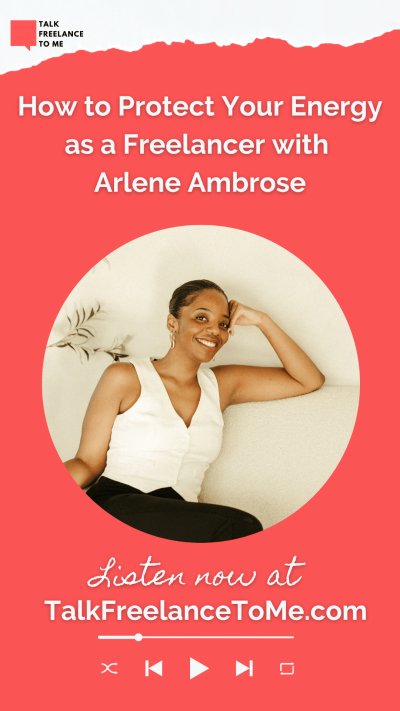
Click the player above to listen to the episode. Or listen on your favorite podcast app! We’re on all major podcast platforms including: Amazon Music, Apple Podcasts, Spotify, YouTube Music, and iHeart Radio, to name a few. You can also watch the interviews on our YouTube channel.
Table of Contents
- Are you creating a freelance business that supports your well-being, or one that silently drains it?
- Key Takeaways
- Time Stamps
- About Arlene Ambrose
- Noteworthy Quote From This Episode
- Listen Now
- Watch This Interview on YouTube. Subscribe Here!
- Diversify Your Freelance Business
- Let’s Get Social
- Frequently Asked Questions (FAQ) From This Episode
- Read The Transcript
- The Connection Between Holistic Care and Everyday Wellness
- What Early Stress Signs Should Freelancers Watch For?
- Why Do Freelancers Overlook Stress Warning Signs?
- How Can We Rewrite Old Beliefs About Rest?
- Structuring a Multi-Passion Freelance Business
- How Arlene Attracts Freelance Clients and Builds Visibility
- Why Must Freelancers Own Their Audience?
- How Can We Use Seasonality to Prevent Burnout?
- Planning Your Freelance Year
- Turning Down the Noise in Freelance Culture
- Why Does Building a Genuine Audience Matter?
Are you creating a freelance business that supports your well-being, or one that silently drains it?
In this episode of The Talk Freelance To Me® Podcast, host Ashley Cisneros Mejia sits down with registered nurse, wellness educator, and creative entrepreneur Arlene Ambrose to talk about the intersection of health, creativity, and freelance sustainability. Arlene brings her deep clinical background from emergency rooms and rural healthcare into an eye-opening conversation about stress, seasonal work rhythms, and the importance of building a business that doesn’t ignore your body.
This conversation is a must-listen for any freelancer feeling the pressure to keep pushing, producing, and overdelivering. Arlene’s perspective is a reminder that rest isn’t a reward … it’s an essential part of the work.
Key Takeaways
- Chronic stress often shows up quietly — in sleep changes, digestive issues, irritability, anxiety, and difficulty focusing.
- You don’t have to wait until burnout to make changes. Small daily adjustments make the biggest difference.
- Most freelancers don’t notice the signs because they’re used to juggling multiple responsibilities.
- Simple practices like routine self-check-ins, seasonal planning, and intentional rest can dramatically reduce stress and prevent burnout.
- Holistic care integrates physical, emotional, and lifestyle factors — an approach especially helpful for freelancers whose work depends on creativity and mental stamina.
- You don’t have to wait until burnout to make changes. Small daily adjustments make the biggest difference.
Time Stamps
2:07 — Meet Nurse and Health Writer Arlene Ambrose
4:14 — Integrating holistic and medical care; self-care basics
8:42 — Early signs and impact of stress in freelance; stress is not always bad
13:08 — Physical symptoms and personal stories about stress
14:37 — Strategies for recognizing and managing stress
16:41 — Cultural attitudes toward work, rest, and stress
18:43 — Mindset shifts and daily practices for creatives and freelancers
21:14 — Productivity vs. rest; Pomodoro technique and creative flow
24:57 — Shifting beliefs about rest and productivity
27:06 — Structuring a freelance business; niching down and finding alignment
29:35 — Building a personal brand vs. freelance client work
32:28 — Seasonality in business and health; planning for busy and slow periods
36:12 — The importance of intentional work and avoiding busywork
41:15 — Faith, mindset, and resilience in freelancing
47:00 — Building community and trust through content and social media
About Arlene Ambrose
Arlene Ambrose is a Canadian-based health writer, registered nurse, and well-being educator. She has expertise in emergency room nursing, post-anaesthetic recovery room care, and travel nursing. She’s knowledgeable in several fields of health but is particularly passionate about slow living, self-care, stress management, and lifestyle medicine. She views these as powerful strategies for preventing and treating chronic illness while promoting overall well-being. Follow Arlene on Instagram and sign up for her newsletter, A Moment of Pause.
Noteworthy Quote From This Episode
“There’s something called the default mode network in our brain when we’re resting. Even in just 5 or 10 minutes of rest, that default mode network is helping you tune into your creativity, refresh your mind, and grow. That’s what’s actually happening when you’re resting.”
Arlene Ambrose
Listen Now


Click the player above to listen to the episode. We’re also available on all major podcast platforms including: Amazon Music, Apple Podcasts, Spotify, YouTube Music, iHeart Radio, Podcast Addict, and Deezer. You can also find all episodes on our Buzzsprout page and watch our interviews on our YouTube channel. Get more info about our freelance podcast here.
Watch This Interview on YouTube. Subscribe Here!
Diversify Your Freelance Business

Discover 220+ freelance service ideas to diversify your income using the skills you already have. This free guide helps writers and creatives expand into new offers, niches, and formats—without starting from scratch. Get your diversification guide here.
Let’s Get Social
Love the podcast so far? Rate and review us if you use Apple Podcasts and join in the freelance conversation on Instagram, Facebook, TikTok, Twitter/X, and YouTube! You can also connect with Ashley on LinkedIn and check out our boards on Pinterest!
Frequently Asked Questions (FAQ) From This Episode
What makes freelance stress different from traditional job stress?
Freelancers manage inconsistent income, client expectations, marketing, admin work, and creative output — all without a team. That combination creates a unique, layered stress load.
What is one small change I can make today to reduce stress as a freelancer?
Take a five-minute check-in break. Ask yourself how you feel physically and mentally, and adjust your schedule accordingly.
How do I know if I’m experiencing burnout?
Burnout usually shows up as exhaustion that doesn’t go away with rest, emotional detachment, reduced creativity, and losing interest in work you normally enjoy.
How does holistic care help freelancers long-term?
It treats stress from multiple angles — physical, emotional, lifestyle, and environmental — rather than offering one-size-fits-all advice.
When should I seek outside help?
If stress affects your sleep, mood, health, or your ability to run your business, it’s time to talk to a professional, whether that’s a therapist, counselor, coach, or holistic practitioner.
Read The Transcript
Meet Arlene Ambrose
Welcome to another episode of the Talk Freelance to Me Podcast®! I’m your host, Ashley Cisneros Mejia. Today I’m excited to introduce you to someone who has genuinely inspired me and reminded me to prioritize self-care.
The wonderful Arlene Ambrose is here. How are you today, Arlene?
Arlene Ambrose:
Hi, Ashley. I’m good. Thank you for having me.
Ashley Cisneros Mejia:
I was telling you earlier that I spent time going through your Instagram. Your content on self-care, giving ourselves permission to be human, and not treating ourselves like productivity machines has been a major reminder for me.
Your background is so interesting. You have a strong clinical nursing foundation, and you’re also an amazing writer. Can you tell us how you first started blending those two worlds?
Arlene Ambrose:
I’ve always been creative. When I was deciding what to study, I felt torn between journalism and the healthcare field. At the time, I didn’t have creative people in my family, and I was living alone in Toronto, so choosing nursing felt like the stable option financially.
But I never stopped creating. Writing and creativity helped me through difficult days and heavy work seasons. I just never saw it as something I could do professionally.
One day, when I was teaching, a student mentioned she worked at a facility that used art therapy and other creative therapies as part of their healthcare model. She invited me to visit. That moment made something click — you really can do creative work that supports health because humans are whole beings.
I started with art therapy, then took a course in poetry therapy. At the same time, I was seeing patients come in with stress-related conditions — heart attacks, emotional distress, chronic issues. We treated the physical side, but the emotional piece wasn’t being addressed. I wanted to bridge that gap.
So that’s how I began merging the two worlds.
Ashley Cisneros Mejia:
That’s so interesting. Are you still nursing, or have you moved entirely into writing, coaching, and supporting people in other ways?
Arlene Ambrose:
I still do nursing. I genuinely love both.
I’ve always worked in emergency care, surgery, and rural or outpost settings. I do some flight nursing as well. When something catastrophic happens, medical care is essential, and I love being part of that environment.
I also work in rural Indigenous communities in Canada where there may not be a doctor. These facilities are understaffed and under-resourced, and I find that work meaningful.
Alongside that, I do my writing and workshops. Keeping both worlds active feels right to me.
The Connection Between Holistic Care and Everyday Wellness
Ashley Cisneros Mejia:
That blend of clinical care and holistic support is so powerful. I’ve been thinking a lot about this because my grandmother has Alzheimer’s. While there’s no cure, I’ve been reading research about prevention — exercise, diet, and basic lifestyle habits.
Your content gives those gentle nudges: drink water, move your body, slow down. It reminds me how much we could prevent if we stopped ignoring our needs. In many places around the world, there’s such pressure to work nonstop, pay bills, and be productive that self-care gets pushed aside.
Arlene Ambrose:
Absolutely. And that pressure shows up in the clinical setting. During my coaching program, I realized even I wasn’t taking care of myself. I was always working.
When I started making small changes — drinking water, slowing down — I became more aware of how many patients were coming in with stress-related conditions. Heart attacks, strokes, mental breakdowns. So much of it linked back to chronic stress.
Seeing that over and over opened my eyes.
What Early Stress Signs Should Freelancers Watch For?
Ashley Cisneros Mejia:
That makes so much sense. You mentioned stress as a major factor. What early signs should we look out for? Especially for freelancers and creative freelancers who often push through deadlines without checking in on themselves.
Arlene Ambrose:
The first thing I want people to understand is that stress isn’t the enemy. Stress is necessary. It helps us wake up, take action, and focus.
Stress becomes harmful when it’s chronic and unmanaged. Chronic means it’s ongoing for a month or more with no sign of improvement. Unmanaged means you aren’t using any tools to support yourself emotionally or physically.
Most people don’t recognize their own signs of stress. We’re so used to pushing through that we miss the early cues.
Here are some common ones:
- Changes in sleep
- Persistent dread or anxiety
- Heart palpitations
- Nausea or digestive changes
- Skin flare-ups, breakouts, or inflammation
- Forgetfulness or difficulty concentrating
At one point, I was so stressed that my face swelled, I couldn’t breathe properly, and my inflammatory markers were extremely high. Doctors cleared me medically and told me it was stress.
Once I rested and took care of myself, everything calmed down. It taught me how strong that mind-body connection is.
For freelancers, especially freelance writers, tracking your mental, emotional, and physical cues is essential. A journal helps you connect the dots — what triggered the response, what your body did, and what helped.
Why Do Freelancers Overlook Stress Warning Signs?
Ashley Cisneros Mejia:
That’s powerful. And I think you’re right — many of us grew up in work cultures where pushing through was admired. People would come to work sick, and it was framed as dedication.
Freelancers deal with similar pressure. We hop from deadline to deadline, often without evaluating how we feel or why our habits change. Maybe suddenly we’re drinking two espressos instead of one, or staying up snacking instead of sleeping.
When creative freelancers like us feel stuck in go-mode, what mindset shifts or daily practices help?
Arlene Ambrose:
Many people fear rest because they think it’s the opposite of productivity. But rest and productivity are two sides of the same coin.
When you have a deadline, that surge of energy you feel is stress doing its job — helping you move forward. But you still need strategic rest.
A few tools I recommend for freelancers and creative professionals:
1. Break large projects into smaller steps.
I use a simple Kanban board made of sticky notes. Yellow notes list the tasks, red notes mark what I need to do right now. It keeps things manageable, especially with multiple client projects.
2. Use time-blocking methods like the Pomodoro technique.
Work for 30 minutes, take a 5-minute reset. Those short breaks activate the brain’s default mode network, which fuels creativity, problem-solving, and emotional processing.
3. Remove guilt from the process.
This one is huge for freelancers. You can work hard when you need to. You can rest when you need to. Neither makes you lazy. Both are part of doing good work.
When you integrate rest intentionally, you produce better writing, better ideas, and fewer burnout cycles.
How Can We Rewrite Old Beliefs About Rest?
Ashley Cisneros Mejia:
That makes so much sense. And it’s a shift many freelancers have to make. A lot of us grew up believing rest was something you earned only after nearly burning yourself out.
I’ve been trying to unlearn that. And your perspective helps because you’re calling out that rest isn’t absence — it’s part of the creative process.
You do so much between nursing, writing, teaching, and helping people. Can you talk about how you structure your business and offerings? And what advice do you have for freelance writers and education-minded creative freelancers who want to build something similar?
Structuring a Multi-Passion Freelance Business
Arlene Ambrose:
The main thing I’ve learned from experience is that you can’t do everything at once. Something will suffer.
I do a variety of things — nursing, writing, workshops — partly because I’m exploring what aligns with me long-term. Freelancers often start with a wide net, and that’s okay. It helps you discover what comes naturally, what feels effortless, and what actually generates income.
Here’s what helped me:
Separate what you love from what pays.
Those two things aren’t always the same, and that’s okay. I tried monetizing every skill at first, and it didn’t work. Some things I do for creativity and community, not revenue. Other things are my actual income streams.
Like nursing — I still do contract nursing because it’s flexible and steady. It gives me financial grounding so I can experiment creatively without desperation.
Find the thing you come back to.
I ask myself constantly: what do you always return to? For me, it’s writing and health. So everything eventually narrowed back to those two pillars.
How Arlene Attracts Freelance Clients and Builds Visibility
Arlene Ambrose:
When I started, I wrote on Medium, built my Instagram presence, and focused on my newsletter. Those are my visibility tools.
People find my writing, then follow the links to my Instagram, then sign up for my newsletter. One girl recently told me, “I found your article on Medium, then went down the rabbit hole and joined your list.” That’s how a brand ecosystem should work.
When I worked with a mentor, she told me something that changed everything:
Your entire strategy needs one goal.
At the time, my one goal was simple: get people on a call or get them on my email list. Everything pointed back to that.
Freelancers can waste a lot of time doing “busy work” — posting everywhere, dabbling, following trends — but none of it moves the business forward. You need to choose the one outcome that matters.
I recommend setting two core goals:
- A client-focused income goal
- A personal brand visibility goal
Relying only on clients is unstable. You also need your own brand — a place where people find you, not the other way around.
Why Must Freelancers Own Their Audience?
Arlene Ambrose:
You don’t want to send people in 50 different directions. Funnel them to where you want them to go.
For me, that’s Instagram and my newsletter. My audience is full of women seeking rest and self-care, so when I offer a workshop or digital product, it’s aligned with what they already expect from me.
I’ve booked writing assignments and speaking engagements simply because people found me through my Instagram. Someone found a post, reached out, and asked me to talk about stress management. You truly never know who’s watching.
Ashley Cisneros Mejia:
That’s beautiful. And it’s such an important reminder. Freelancers care deeply about client work — we want to help them hit their goals, deliver great results, and be reliable.
But we can’t neglect ourselves, our own self-care, or our personal brand. We still need our own foundation aside from client work.
I love how you’ve built that balance.
I also noticed you talk a lot about seasonality — in business and in health. That idea really speaks to me. My kids are about to get out of school for the summer here in Florida, and for the first time, I’m giving myself permission to scale back.
In the past, I tried to operate like nothing changed during summer break, and it led to frustration and burnout. What does seasonality look like for you, and how can creative freelancers use it to avoid burnout?
How Can We Use Seasonality to Prevent Burnout?
Arlene Ambrose:
The first thing I want everyone to read is the book Slow Productivity by Cal Newport. It reinforces this idea that deep focus in the right season allows you to create an incredible amount of work in a short period — like writing a book draft or building a full content library.
I use that approach constantly. When I’m in a focused season, I batch everything.
I’ll write months of newsletters, months of Instagram content, and schedule it all.
That way, when I enter a different season — maybe a nursing contract or client-heavy writing season — all the background content is already running. My energy is reserved for the project at hand.
It keeps me from juggling everything at once.
Another book I recommend is The One Thing by Gary Keller. It challenges the idea of multitasking. You can technically do many things, but you won’t do them well or fast. Focusing on one thing at a time not only helps you produce better work — it creates more space for rest.
Let me give you an example. I was on a nursing contract in Canada — usually I take contracts for two or three months at a time. After that, I’ll switch into a writing season.
At one point, I started getting anxious about what was coming next. As freelancers, we always wonder where the next project or income will come from, right?
So I pushed myself into a travel nursing contract in New York before the timing was right. I forced it.
It turned into busy work. I spent more time, money, and energy than I gained. I came home exhausted… and with less money than before. That experience taught me a lot. I could have stayed where I was, trusted the season I was in, and been better off.
Seasonality requires planning. It requires trust. And it requires honesty about your capacity.
Planning Your Freelance Year
Arlene Ambrose:
Look at your entire year. Look at your family responsibilities. Look at your energy cycles. Look at the patterns in your creative work.
If you know your kids will be home in the summer, then January through April becomes a “go hard” season. You work deeply, intentionally, and stack projects, submissions, or business development.
Then summer arrives, and you shift to a lighter pace — maybe you take on fewer client projects, maybe you focus on planning, visioning, or exploring new ideas. Working less does not mean producing less.
Intentional work always beats frantic work.
Ashley Cisneros Mejia:
That lands so deeply. And it’s something freelancers struggle with constantly. We’re aware of what everyone else is doing — retreats, courses, new offers — and it’s easy to think we should be doing all of it too.
But that may not be part of our goal, our season, or even our desire. I love how your mentor helped you stay centered by focusing on the one metric that mattered at the time. If something didn’t support that goal, it could wait.
Arlene Ambrose:
I ask myself every day, “What’s the end goal?” And then I ask, “What can I get rid of?” I’m always removing something from my schedule.
There’s a fear of missing out, especially online. It’s easy to see what other freelancers or creative entrepreneurs are doing and think we need to copy it. But you can’t do everything at once, and you’re not meant to.
You’re on a different path. Your timeline is different. Your capacity is different.
You can do everything you want eventually — just not all at the same time.
Turning Down the Noise in Freelance Culture
Ashley Cisneros Mejia:
Exactly. And in the freelance world, there’s nonstop noise. Some people say the economy is collapsing. Others say AI will erase us. There’s so much fear-based messaging.
Sometimes the smartest thing we can do is turn off the noise, check in with ourselves, and ask, “What do I actually want? What feels right for my business?” Otherwise, we end up working hard but not moving forward — just treading water.
And that’s why I find your Instagram space so refreshing. There’s no scarcity mindset. There’s no panic. There’s faith, calm, and trust. Can you talk about how your faith plays a role in the way you navigate freelancing and life?
Arlene Ambrose:
My faith shapes everything. I come from an immigrant family and I’m the eldest daughter, so I feel responsibility. When work is inconsistent — which happens with contracts and freelance writing — it can trigger anxiety.
But time and time again, I’ve seen that I’m never actually left without options. Even in seasons when I wasn’t working for months, something always opened up just as I was losing hope.
That’s not luck to me — that’s faith.
I also want to be honest: many times the opportunities I received were ones I didn’t feel fully qualified for. And yet someone chose me anyway. People often tell me they “just have a feeling” about working with me.
So much of that is faith, intuition, and the way connection works between people.
Why Does Building a Genuine Audience Matter?
Ashley Cisneros Mejia:
Absolutely. And your audience feels that connection. Many of the people in your community have followed your writing, your posts, your reflections — they already trust you.
So when you release something, whether it’s a workshop or a new offering, they’re already invested in you as a person and as a guide.
Arlene Ambrose:
Yes, and that’s the other half of it. People will sometimes message me asking when the next workshop is or what topic I’ll teach on next.
Even when it seems quiet, people are watching. People notice when you’re gone. I once took down an Instagram account I used for writing because I felt like no one was reading. And people reached out asking where I went.
That taught me a lot. Engagement doesn’t always look like likes or comments. Sometimes it’s silent, but the connection is real.
Even if it’s only one person — it matters.
Ashley Cisneros Mejia:
This is all so good, Arlene. Thank you for sharing these reminders. I can’t believe we’re already in the middle of the year, but everything you’ve said feels grounding — especially for those of us navigating freelance writing, creative work, and family life at the same time.
Where can people stay connected with you, learn more about your work, and keep up with what you’re creating? And is there anything we should look forward to?
Arlene Ambrose:
I’m most active on Instagram at @thearleneambrose.
You can also sign up for my newsletter through my website, arleneambrose.ca — all the links are there.
As for what’s coming, I would love to create a book. My writing style blends poetry and narrative, and it doesn’t always fit neatly into traditional publications. So I want to create something of my own — something that reflects that voice. That’s the project I’m dreaming about next.
Ashley Cisneros Mejia:
That’s so exciting. Everyone go follow Arlene so you can be the first to know when her beautiful work is ready.
Arlene, thank you again for being on the show. I appreciate your wisdom, your honesty, and the calm clarity you bring to conversations about work, wellness, and life as a freelancer.
Arlene Ambrose:
Thank you so much for having me.